
SSL VPN vs. ZTNA: Why Organizations Are Rethinking Remote Access
Remote work isn't going away, but the way organizations secure remote access is changing rapidly.
For years, SSL VPNs have been the standard solution for connecting remote employees to corporate networks. While VPNs were designed to provide secure access, today's cybersecurity landscape has exposed limitations that make traditional remote access models increasingly difficult to defend.
As organizations adopt cloud applications, hybrid work environments, and Zero Trust security frameworks, many are shifting their focus from VPNs to Zero Trust Network Access (ZTNA).
The Challenge with Traditional SSL VPNs
SSL VPNs were designed during a time when users primarily worked from trusted devices and accessed resources located within a corporate network.
The model is straightforward: authenticate the user, establish a secure connection, and grant access to the network.
While effective for many years, this approach presents several challenges:
Broad Network Access
Once connected through a VPN, users often gain visibility into large portions of the corporate network, even if they only require access to a single application.
This increases the potential attack surface and creates opportunities for attackers who successfully compromise credentials.
Increased Security Risk
Cybercriminals continue to target VPN infrastructure through credential theft, phishing attacks, and exploitation of software vulnerabilities.
A compromised VPN account can potentially provide an attacker with a foothold inside the network.
Complex User Experience
VPN connections can introduce performance issues, connectivity challenges, and additional support requirements for IT teams.
As organizations continue to embrace cloud-based applications, routing traffic through a VPN may no longer be the most efficient approach.
What is Zero Trust Network Access (ZTNA)?
ZTNA is built on a simple principle:
Never trust. Always verify.
Rather than providing access to an entire network, ZTNA grants users access only to the specific applications and resources they are authorized to use.
Every access request is evaluated based on factors such as:
- User identity
- Device health and security posture
- Multi-factor authentication status
- Location and contextual risk factors
- Application-level permissions
The result is a more secure and controlled access model.
Key Benefits of ZTNA
Reduced Attack Surface
Users can only access the applications they need, rather than gaining visibility into the broader network.
This significantly limits opportunities for lateral movement if credentials are compromised.
Continuous Verification
ZTNA continuously evaluates trust throughout a session rather than relying on a one-time authentication event.
Access decisions can adapt based on changing risk conditions.
Improved Security Posture
By enforcing least-privilege access, organizations can better protect sensitive data and critical business applications.
Better Support for Hybrid Work
ZTNA was designed for today's distributed workforce and cloud-first environments, providing secure access regardless of user location.
Simplified User Experience
Users gain seamless access to authorized applications without the complexity of traditional VPN connections.
SSL VPN vs. ZTNA: A Quick Comparison
| SSL VPN | ZTNA |
|---|---|
| Network-level access | Application-level access |
| Trust once connected | Continuous verification |
| Larger attack surface | Reduced attack surface |
| Designed for traditional networks | Designed for cloud and hybrid environments |
| Broad visibility into resources | Least-privilege access model |
The Future of Secure Remote Access
SSL VPNs are not disappearing overnight, and many organizations will continue to rely on them for certain use cases. However, as cybersecurity threats evolve and organizations embrace Zero Trust strategies, ZTNA is becoming a preferred approach for securing remote access.
The conversation is no longer just about connecting users to the network. It's about ensuring users have secure access to exactly what they need—and nothing more.
Organizations that embrace Zero Trust principles today will be better positioned to protect their users, applications, and data tomorrow.
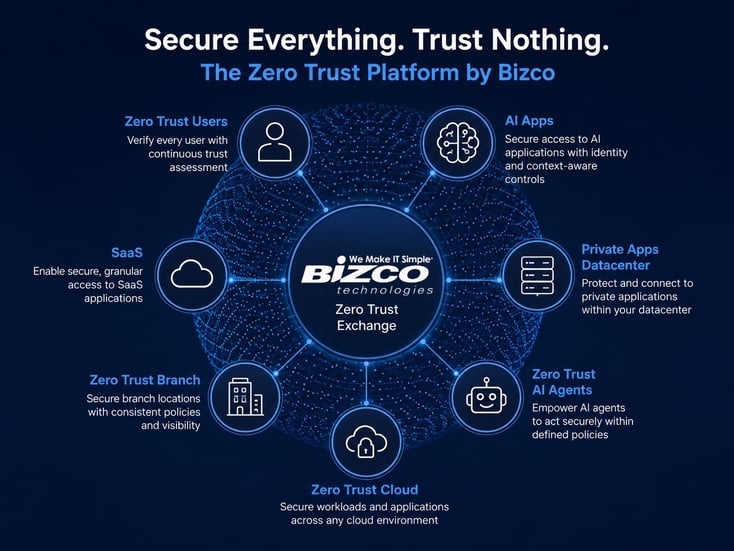
How Bizco Technologies Can Help
Transitioning from traditional VPN infrastructure to a Zero Trust architecture requires careful planning and the right technology strategy.
Bizco Technologies helps organizations evaluate their current remote access environment, identify security gaps, and implement modern solutions that align with Zero Trust best practices.
Whether you're looking to strengthen security, improve user experience, or support a growing hybrid workforce, our team can help you build a more secure future for remote access.